
Test 3
Section 1
Complete the form below.
Write NO MORE THAN THREE WORDS AND/OR A NUMBER for each answer.

Questions 9 and 10
Choose the correct letter, A, B or C.
- The man decides to book
- a three-course meal.
- a buffet.
- a banquet.
- The man will have to pay
- £750 tomorrow.
- £100 per head.
- £1,500 on the day of the party.
Section 2
Questions 11-17
According to the speaker, when did the following happen?
Write the correct letter A, B or C, next to Questions 11-17.
A before 1837
B between 1837 and 1900
C after 1900
11 The East Front was added to the building. ........................
12 The last big structural change was made. ........................
13 The building was bombed. ........................
14 The building became a palace. ........................
15 The building was known as The Queen's House. ........................
16 The Houses of Parliament were destroyed by fire. ........................
17 The Marble Arch was moved ........................
Questions 18-20
Complete the sentences below.
Write NO MORE THAN THREE WORDS AND/OR A NUMBER for each answer.
18 Up to ........................ people attend garden parties at the palace each year.
19 The garden contains more than ........................ species of wild flower.
20 The public can visit the nineteen ........................ in August or September.
Section 3
Answer the questions below.
Write NO MORE THAN THREE WORDS AND/OR A NUMBER for each answer.
21 What aspect of history is it important to learn something from?
______________________________________________
22 What do we also need to know about our ancestors?
______________________________________________
23 Where are transferable skills useful?
______________________________________________
24 What kind of approach to learning does social science use?
______________________________________________
Questions 25-30
What is said about each of these subjects studied on a social studies course?
Choose your answers from the box and write the letters A-H next to questions 25-30.
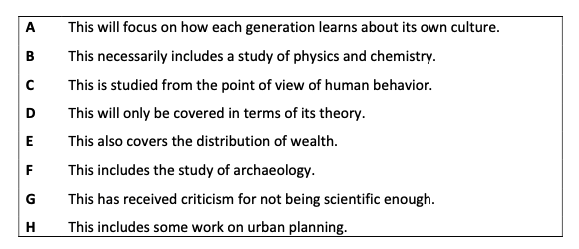
25 Anthropology ...............
26 Economics ...............
27 Education ...............
28 Geography ...............
29 Law ...............
30 Sociology and social work ...............
Section 4
Questions 31-37
Choose the correct letter, A, B or C.
- Students should complete their work on the 1950s
- if they want to be allowed to continue attending lectures.
- because they will appreciate the information about the 1960s more.
- otherwise they face the possibility of being failed for their coursework.
- According to the lecturer, the ‘baby boom’ happened
- because of relaxed attitudes in the sixties.
- during a time of war.
- because people felt more secure.
- In the sixties, the USA had 70 million
- teenagers
- babies
- adults
- According to the lecturer, compared to the 1950s, the 1960s were
- less conservative.
- more conservative
- just as conservative.
- According to the lecturer, literature changed the way women
- over 40 were treated by society.
- viewed issues of race in society.
- felt about their roles in society.
- The rate of crime in the sixties
- rose nine per cent during the decade.
- was nine times higher than in the fifties.
- was nine times lower than in the fifties.
- What happened at the start of the 1960s?
- he first heart transplant
- the introduction of the internet
- the invention of lasers
Questions 38-40
Complete the summary below.
Write NO MORE THAN THREE WORDS for each answer.
In October, 1962, US President Kennedy met advisers to discuss 38 ................. which proved that the Cubans were installing nuclear missiles, presumably to use against the US. Kennedy was faced with three choices: to try to resolve the crisis diplomatically; to block the delivery of further weapons into Cuba, or to attack Cuba. Kennedy chose 39 ..................... option, which prevented the build-up of more missiles and led to the withdrawal of the existing ones. Most are agreed that a 40 ....................... was narrowly avoided by Kennedy's decision.