
SKILL 2 SPEAKING
General Strategies For Speaking IELTS
2. GENERAL STRATEGIES
This section introduces strategies that can be used in all three parts of the test. The strategies will be briefly introduced in this section, and then the way to use these strategies will be explained under each part of the test.
BAD EXAMPLE OF A SPEAKING TEST:

It is really important to produce language in the test to get a good score for all four grading criteria. The example above fails to do this. It is very short so the examiner is not able to see any fluency. Very few words have been spoken so it is difficult to assess pronunciation, vocabulary, and grammar.
The strategies outlined below can be used in all three parts of the test to extend your answer. You may also like to see my YouTube video on this topic. It is my most popular video with hundreds of thousands of viewers!
https://www.youtube.com/watch?v=j4VYB-hXNkw
The strategies below are used to answer the question:

1. DIVIDE INTO 2 OR 3 PARTS:
This strategy involves giving 2 or 3 reasons for your answer, as follows:
Well, there are three kinds of food that I’m really keen on.
The one I like best is Italian food because...
I also really like to eat Korean food as it’s very...
I’m also kind of partial to Mexican food because it is...

2. GENERAL TO SPECIFIC
This strategy involves giving a general reason for your answer, and then explaining it more specifically, and even giving an example as follows:

general = seafood
specific = Japanese seafood
example = sashimi
3. DEPENDS: describing different situations
This strategy involves giving different reasons for different situations for your answer, as follows:

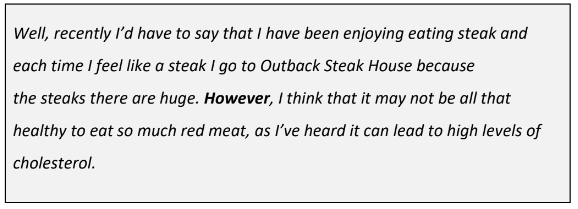
4. CONCESSION:
This strategy involves making a main point and then giving a counterargument to it, as follows:
5. AVOIDANCE:
This strategy involves not directly answering the question at first, and then answering it, as follows:

Avoiding phrase = Well, to be honest, I don’t really have...
p>Answering phrase = but I guess that if I had to choose one...Your grade for fluency requires that you speak at a good speed. You must demonstrate this to the examiner, but you do NOT need to speak quickly throughout the entire exam. Vary your speed as follows:
Slow down when you...
- reach a difficult area or are unsure of what you will say
- want to emphasize something
- are using high level language to make the examiner notice it
Speed-up when you...
\- are comfortable with the topic and what you are saying
- are giving less important information
Use redundant language
Redundant language is words that don't have any real meaning such as: oh, well, actually. Research shows that native speakers use lots of redundant language, but non- native speakers rarely use it. So use it to be more native-like!
Use punctuation
When we speak we use punctuation. Spoken punctuation takes the form of pauses and these pauses act like punctuation in writing. They guide the listener. A short pause signals a new clause. A longer pause with a breath of air signals a new idea. And, an even longer pause signals a change of topic.
comma = short pause
full-stop = longer pause with a breath of air
paragraph= even longer pause
Adjectives make things more interesting. There is a difference between eating a nice dessert, and eating a bowl of the freshest, sweetest fruit, topped with a delicious chocolate sauce! Adverbs allow you to explain an activity more precisely. Again, there is a difference between running and running swiftly.
Adjectives and adverbs increase the precision of your language and this increases your score for vocabulary.
We can also use adverbs with adjectives to add even more precision and show even more talent with vocabulary to the examiner. The following adverbs are organized from providing weak modification to strong modification of an adjective:
slightly tiring
fairly tiring
particularly tiring
really tiring tiring
extremely tiring tiring
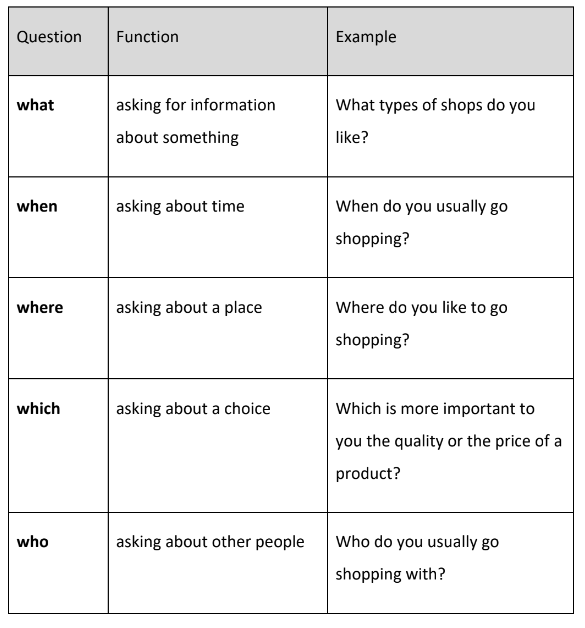
In English the key words of questions usually come at the very start of the sentence. If you miss this word, you may struggle to know what the examiner is asking. Some common question words are listed below:
When the time comes for your speaking test you will enter a room with a table and two chairs and usually sit opposite the examiner. In theory, your test does not begin until after the examiner has checked your identification (passport). In reality though, as soon as you enter the door the examiner is forming an opinion about you!
You may feel nervous. It's pointless to tell the examiner you feel nervous as they hear this often. The best thing is to try to hide the nervousness. Try to show confidence and calmness. Try to show the examiner that you are confident to speak English. It can be helpful to smile at the examiner to establish warmth between you. Overall, you don't really need to worry about doing anything because the examiner is experienced and will guide you through the process of the exam.
Before your test starts the examiner needs to record some details such as the date and time. You should stay silent during this. However, you can use this as an opportunity to get accustomed to the examiner's accent and pronunciation. Essentially, you can be tuning your listening to make it easier to catch the questions when the examiner starts asking them.
The examiner also needs to check your identification and will ask you a few questions such as: What is your full name? Where are you from? Can I see your identification please? The test has started at this point, but just give simple answers to these questions. This is not the time to be giving extended answers. You will frustrate the examiner if you do this!
After the examiner has finishing checking your identification the examiner will say something like "Now, I would like to ask you a few questions about yourself" and the examiner will introduce a topic and start asking you questions about it.
SKILL 3 SPEAKING
Structural Language for Speaking Part 1 IELTS
3. PART ONE: QUESTIONS ON FAMILIAR TOPICS

Requirement
This part of the test lasts from 4 to 5 minutes and consists of questions about you and the country you are from. In this part of the test the examiners read questions directly from their examiner's book. There is a maximum of three different sets of topics and each topic has a maximum of four questions. The first topic will be about whether you work or study, the place you are living in, or the place you are from. The other two topics are usually fairly straightforward topics such as hobbies, holidays, sports, or entertainment.
Procedure
- After checking your ID the examiner will start Part One of the test.
- The examiner will say: "Now, I am going to ask you a few general questions"
- The examiner will ask three or four questions according to different topics. The examiner will then introduce the topic by saying something like: "Now, let's talk about where you live"
Make sure you pay attention to the keywords the examiner uses to introduce the topic. This is because you will have three or four questions based on this topic and you want to be clear what the topic is about.
- The examiner will ask you three or four questions based on the topic, such as:
Do you live in a house or an apartment?
Which room do you like the most in your home?
In the future, what sort of home would you like to live in?
- When the examiner has finished asking you 3 or 4 questions based on the topic, the examiner will move onto the next topic, by saying something like:
"Now let's talk about your hobbies and interests"
- After three sets of topics [each with three or four questions] the examiner will finish Part One and move onto Part Two of the test. Note that Part One of the test lasts 4 to 5 minutes. If you give longer answers, it is possible that you may only get two topics. This could be an advantage because there is less chance of getting an unfamiliar topic!
3.1 STRATEGIES
1: Expansion
Expansion is making something bigger. In IELTS it is good to give expanded answers to questions. This shows that you understand the question, and gives you more chance to show your language ability and get a higher score. This is illustrated below:
QUESTION: Do you like riding bicycles?
BAD RESPONSE: "Yes"
BETTER RESPONSE: "Yes, because it’s fun, good for health, and doesn’t cost a lot."
GREAT RESPONSE:

You should refer back to Chapter 2 about the different ways to expand your answers which include:
- Dividing your response into two or three parts:
- Explaining something from general terms to specific and maybe giving an example
- Depends: describing different situations
- Concession: making a main argument and then giving a concession to it
- Avoidance: not directly answering the question at first and then answering it
2: Show language
QUESTION: What colors do you like?
BAD RESPONSE: "I like green and blue."
[This answer has no advanced vocabulary.]
BETTER RESPONSE: "My favorite colors are light green and navy blue."
EVEN BETTER RESPONSE:

This answer uses some less common colors, and can impress the examiner with your vocabulary about colors. It also includes the idiomatic expression "I'm really into." This means to like something.
3. Buy time to think
There are a few ways to buy some time to think of your answer. Note that you shouldn't use any particular method too often! Use a range of these methods below:
Repeat the question: One way to do this is to rephrase the words of the question "Oh, so you're asking about my favorite color."
Ask the examiner to repeat the question: In Part One of the test the examiner is permitted to repeat the question one time. Note that the question cannot be repeated a second time and the examiner is not supposed to rephrase the question. You could ask the question to be repeated just so that you can have time to think of how to respond to it. Essentially, while the examiner is repeating the question you are thinking of what you can say. Doing this once won't lower your score, but obviously if you do it often it will lower it!
You can use language like: "I'm sorry I didn't quite catch that...could you please repeat the question."
Use some memorized phrases to start your answer: if you memorize a few phrases, while you are saying these phrases you can be thinking of how you will actually respond to the question. Some phrases could be:
"Well, that's a really interesting question"
"Oh I'm not too sure about that... Let me think for a minute...Oh yes it is...."
"With regards to your question, I guess I would have to say that....."
4. If you don't understand the question
If you do not hear or understand the question, the examiner can repeat each question one time. If you do not understand the meaning of a word you can ask the examiner to explain that word. However, the examiner is not able to rephrase the whole question if you are not able to understand it, except in Part Three. If you didn't answer the question it doesn't mean you've failed your exam, but you wouldn't want to do this more than once or twice. If you can't understand the question then tell the examiner. The worst situation is that you stay silent and make the examiner unsure about whether you will give an answer or not. This makes both you and the examiner uncomfortable. Another choice is to listen out carefully for key words in the question and then try to give some sort of response to the question. This is a bit of a gamble! Do you feel lucky?
SKILL 4 SPEAKING
Stategies For Types of Questions (Liking)
3.2 TYPES OF QUESTIONS
Note that this section will use the general strategies outlined in Chapter 2. More than one of the strategies could be used for any particular question. The purpose of this section is to show you how to actually use these strategies to answer questions.
The following types of questions are outlined below:

1. DES CRIPTI ON QUEST IONS
STRATEGY: divide your response into two or three parts
STRUCTURE: point 1 + point 2 + point 3
SAMPLE QUESTION: "Tell me something about your hometown?"

USEFUL LANGUAGE
Starting-off (redundant language)
ok, then; actually; alright; well, you know;
Point 1
I’d like to begin by saying ...
The first thing I’d like to mention is ...
The main thing you need to know is ...
Point 2
On top of that I can also add that ...
Another interesting point ...
Not only that, but _______is also exceedingly .....
Point 3
Finally, I’d also like to mention ........
And, I shouldn’t forget to mention that...
I guess I could also say that (it’s) sort-of ........
Practice Questions:
- What sort of work do you do?
- What does your house look like?
- What does your neighborhood look like?
- What does your city/town look like?
- What sort of clothes do you like to wear?
- Describe a city you would like to visit?
- Describe a country you would like to visit?
- Describe a park you have visited?
2. “TY PES OF” QUEST IONS
STRATEGY: divide into 2 or 3 parts
STRUCTURE: general statement + type 1 + type 2
SAMPLE QUESTION:
"Tell me about the different types of public transportation in your city."

USEFUL LANGUAGE
Rephrasing types: kinds, sorts, variety, range of, array
Useful phrases to start [General statement]
There’s quite a mixed variety of ...
There’s a fairly wide range of ...
There’s quite a diverse mixture of ...
Type 1
I think the most common one is...
The main one is....
The first one that comes to mind is...
Type 2
In addition, X ...is also extremely popular
Another kind is ...
Not only that, but X ...is also exceedingly.....
Type 3 [if needed]
And I shouldn’t forget to mention that...
I guess I could also say that...
Finally, I’d also like to mention...
Practice
- What kinds of restaurants are popular in your country?
- What types of shops can be found in your local area?
- What types of things do people collect in your country?
- How do you spend your free time?
- How do people spend their free time in your country?
- What sorts of TV programs do you watch?
- What sorts of TV programs are popular in your country?
- What sort of things do people collect in your country?
3. LIK ING
STRATEGY: general to specific
STRUCTURE: general statement + more precise statement + reason
SAMPLE ANSWER
"What kind of animals do you like?"

Rephrasing “liking”
I’m pretty fond of...
I’m really keen on...
I’m a big fan of...
I’m extremely passionate about...
General statement
Well, in general I would say ...
Generally speaking...
Overall, I think that...
More precise statement
In particular,
Specifically,....
To be more precise...
Reason
And I guess this is probably because...
I think this is due to the fact that...
The reason for this is because...
Practice:
- What do you like about your hometown?
- What do you like about your job/studies?
- What sort of music do you like?
- What sorts of books do you like reading?
- What type of movies do you like?
- Where do you like to shop?
- What types of food do you like?
- What types of free time activities do you like?
SKILL 5 SPEAKING
Strategies for Types of Questions (Disliking & Habits)
4. DISLIKING
STRATEGY: general to specific
STRUCTURE:General dislike + more precise statement + reason
SAMPLE ANSWER
"Is there anything you don’t like about your hometown?"

Rephrasing “Disliking”
I really can’t stand...
I’m not really fond of...
I’m not much of a fan of...
... simply gets on my nerves.
General statement
Generally speaking...
Well, in general I would say ...
Overall, I think that...
More precise statement
To be more specific...
To be more precise...
Specifically,....
Reason
I think this is due to the fact that...
And I guess this is probably because...
The reason for this is because...
- Is there anything you don’t like about your hometown?
- Is there anything you don’t like about job/studies?
- Is there any food you don’t like?
- Are there any clothes that you don’t like?
- Are there any colors that you don’t like?
- What type of weather do you dislike?
- What type of noises do you dislike?
- What type of movies do you dislike?
5. Habits
STRATEGY: Depends
STRUCTURE: Depends + if preference 1 + if preference 2
[note that the structure uses conditional clauses which can increase your score for grammar]
SAMPLE QUESTION
What do you usually do at the weekend?

LANGUAGE
Depends
Well, it is contingent upon...
I think it depends really.
Well, to be honest, I would have to say that it really depends.
Preference 1
If I’m... I prefer to...
Usually, I prefer...
Sometimes, I prefer to...
Preference 2
But, if I... I would rather...
Although, sometimes I would rather...
However, if I have...
Note: To describe past habits we can also use “used to’ or ‘would”, with an appropriate adverb of frequency:
When I was a child, my brother often used to take me fishing.
My mother would always tell me a story to get me to fall asleep
Practice
- What do you usually do on the Internet?
- Where do you usually study?
- What do you like to do for holidays?
- When do you go shopping?
- What do you do to relax?
- How much sleep do you usually get?
- How do you celebrate festivals in your country?
- How much TV do you watch?
SKILL 6 SPEAKING
Strategies for Types of Questions (Yes-No & WH- Questions)
6. Yes/no questions
STRATEGY: Depends
STRUCTURE: Depends + preference 1 + preference 2
SAMPLE QUESTION
Do you eat healthy food?

LANGUAGE
Depends
Well, to be honest, I would have to say that it really depends.
Well, it is contingent upon...
I think it depends really.
Preference 1
Usually I prefer...
If I’m... I prefer to...
Sometimes I prefer to...
Preference 2
Although, sometimes I would rather...
But, if I... I would rather...
However, if I have...
Practice Questions
- Do you like the weather in your country?
- Do you enjoy eating food from other countries?
- Do you enjoy your work/studies?
- Are there enough festivals in your country?
- Do you enjoy going shopping?
- Do you like to get up early?
- Do you play or watch any sports?
- Are you planning any vacations?
7. “ WH" Qu estions
[these are questions that start with the words: who, where, why, what, and how]
STRATEGY: CONCESSION (making a main point and then giving a concession to it)
STRUCTURE: main point + concession
SAMPLE QUESTION
"What sort of restaurants do you usually eat at?"

LANGUAGE
Concession
Although, I suppose it could be argued that...
However, I'm quite aware that...
Nevertheless, it is worth remembering that...
DIFFERENT TYPES OF "WH" QUESTIONS

PRACTICE QUESTIONS
- What do you do at the weekend?
- WhWhat do you do at the weekend?
- Where do you usually go for holidays?
- Which do you prefer, reading a book or watching T.V?
- Who do you spend your evenings with?
- When do you usually sleep?
- Why do you work/study there?