
SKILL 1 SPEAKING
Asessment Criteria For Speaking IELTS
1. INTRODUCTION
The IELTS speaking test lasts 11-14 minutes. The test is divided into three parts. The IELTS examiner will ask you different types of questions in each part as follows below.
Part 1: Short question and answers about familiar topics.
This part of the test lasts from 4 to 5 minutes and consists of questions about you and the country you are from. There is a maximum of three different sets of topics and each topic has a maximum of four questions. The first topic will be about whether you work or study, the place you are living in, or the place you are from. The other two topics are usually fairly straightforward topics such as hobbies, holidays, sports, and entertainment.
Part 2: Long Turn
You are given a card with a topic and then given 1 minute to prepare a 1 to 2 minute answer to this topic. You should try to talk for 2 minutes if you are able. Topics include describing or commenting on a person, place, object, activity, or experience. The topic also has sub-topics, which are provided to assist you to plan your response. The examiner may ask one or two rounding-off questions at the end of this part of the test. These should be answered briefly.
Part 3: Discussion
This part of the test lasts from 4 to 5 minutes and consists of questions roughly based on the topic area of the Part 2: Long Turn. Questions typically ask you to compare, analyze, speculate, or give your opinion on the given topic. In this part the examiner may push you hard to see the limits of your ability.
Overview of the three parts of the test

1.1 GRADING
Your speaking test is graded and marked from 1-9 in accordance with the four key criteria shown below:
The four criteria are explained in more detail in the sections following the tables. You can also refer to my YouTube videos for further explanation of the grading:
https://www.youtube.com/watch?v=p3uSntDcKTU

[Note that the criteria described in this section are based on the Public Version of the speaking band descriptors at: https://www.ielts.org/PDF/UOBDs_SpeakingFinal.pdf]



FLUENCY AND COHERENCE:
Fluency is about your ability to speak at a normal speed without excessive hesitation and restarting of words or phrases. Coherence refers to your speaking being easy to understand. In order to score highly you need to show willingness to talk at length and develop your topic, use connectives and linking words, avoid pauses and restarts.
Speaking speed
In order to score well, you need to speak at a good speed. This can be challenging when speaking in a foreign language. In order to improve this become familiar with the way the test is conducted, and the types of questions that get asked, so that you are able to respond in a quicker way. In addition, you do not have to speak quickly throughout the whole test you just need to show that you are able to speak at a good speed in parts of the test. Therefore, in areas where you are more comfortable try to speak at a quicker speed to show this ability to the examiner, and in parts that are a bit more challenging you might have to slow down a little.
Hesitations [pauses]
Try to avoid having hesitations in the middle of sentences. These types of hesitations suggest to the examiner that you are trying to think of the necessary words or grammar to complete the sentence. Hesitations at the start of sentences are not as serious as they may be a result of trying to think of ideas for your response to the question. For this reason it is better to hesitate at the start of a sentence rather than in the middle of it.
Transitions and Linking phrases
Transitions are words or phrases that suggest a change in direction to the listener. These include phrases like: in addition, however, consequently. These words increase coherence because the examiner is able to clearly know that you have changed topic or the direction of the topic you are talking about. To increase your score use a wide range of these and don't repeat any phrases excessively.
PRONUNCIATION:
Your grade is influenced by the level to which your accent makes it difficult to understand what you are saying, and also the degree to which you use language features of a native speaker such as chunking, stress, and intonation.
Specific sounds
Many candidates have errors with specific sounds such as: th, w, v, r, l, long vowel sounds [name].
If you think you have these kinds of errors then ask a teacher or at least a native speaker their opinion. And if you do have these errors they are definitely going to have an impact on your score for pronunciation. You must get rid of them! You must practice saying them correctly... and practice doing it every day. This is because our pronunciation is based on habits. We speak without thinking about our actual pronunciation. Therefore if you have a bad habit of mispronouncing a sound you need lots and lots of repetition of saying that sound correctly in order to create a new habit. Bad habits are hard to change!
Chunking
Chunking is how words are characteristically grouped together in spoken segments. You can think of these as being like clauses or sentences when we write. Between these ‘chunks’ you should have pauses at the appropriate places. Think of a comma when speaking as a short pause, and a full-stop is a longer pause including a breath. Each chunk is an idea and the pauses help the listener to know when you are moving onto a new idea. One of the best ways to improve your chunking is to notice the way native speakers naturally do this. Watching movies is a good way to achieve this!
Stress of syllables and words and sentences
Stress has to do with where speakers put the emphasis on particular syllables or words. In English every word has one of the syllables emphasized more than the others [PHOtograph, phoTOgrapher and photoGRAPHIC.] If you incorrectly stress syllables of words, then it can make it difficult for the listener to understand what you're saying. A lack of stress at the sentence level can make your speech sound flat and make it difficult for the examiner to catch the key point of the sentence. As with chunking, one of the best ways to improve this is to notice the way native speakers naturally do this. You also need to understand how altering the stress of words in sentences changes the meaning of the sentence:
I didn't say HE stole the money = I think someone else stole the money
I didn't say he STOLE the money = I think he didn't steal the money...maybe he borrowed it.
Intonation
As with stress above, if you speak without any intonation your speech will sound flat and boring to the examiner. Intonation is about how the tone of the voice rises and falls during speech. This intonation needs to be done naturally or it can have the influence of lowering your score. Essentially, if the intonation occurs in the wrong place or in the wrong way it will lower your score for pronunciation. For instance, we usually end a statement with a falling tone. A rising tone is often used when asking a question that is expected to result in a yes or no answer. This is probably one of the hardest aspects of learning English, and as a result it can be one of the factors that can prevent a score of eight. As with other elements of pronunciation the only real way to make progress here is by observing the way that native speakers naturally use intonation. Actively watching movies and actively noticing the intonation of native speakers is very important.
VOCABULARY: [lexical resource]
To score highly you must use higher level words, pay attention to collocation (which are words that go together). In addition, control your word endings (use the correct form of a word such as noun, verb, or adjective). As well is this, you should try to show ability to paraphrase (rephrase words) and use colloquial language (conversational style language). Show precision with vocabulary by modifying your verbs with adverbs [extremely busy] and nouns with adjectives [magnificent city]
Errors with word choices
Errors with word choices lower your score according to how frequently they occur, whether they are repeated errors or just isolated errors, and also depending on how seriously they interfere with communication. Try to avoid words you are unsure of. However, you do need to show talent to the examiner, so use more advanced language where possible. Remember it is a language test!
Errors with word forms
This is an error where you use the correct word, but not the correct form of the word.
For example, a noun where a verb is needed ("You need to management manage your
business"). These errors are less serious than the errors with word choices, but still
lower your score. If you know you have frequent errors with any aspects such as
confusing adverbs and adjectives then try to work on reducing these errors by doing
quizzes and reviewing the rules.
Lack of talent
In order to get beyond six requires that you show the examiner some advanced language such as idiomatic language or topic-based language. If you have lots of time before your exam, then learn language related to a wide range of topics. I'm also a big fan of learning idiomatic language because it can be applied to a wide range of topics. My main suggestion here is that rather than trying to learn lots of new words and phrases you focus on learning a few well so that you are able to use them effectively in the exam. This is covered in detail in Chapter 6 and 7.
GRAMMAR: [Grammatical Range and Accuracy]
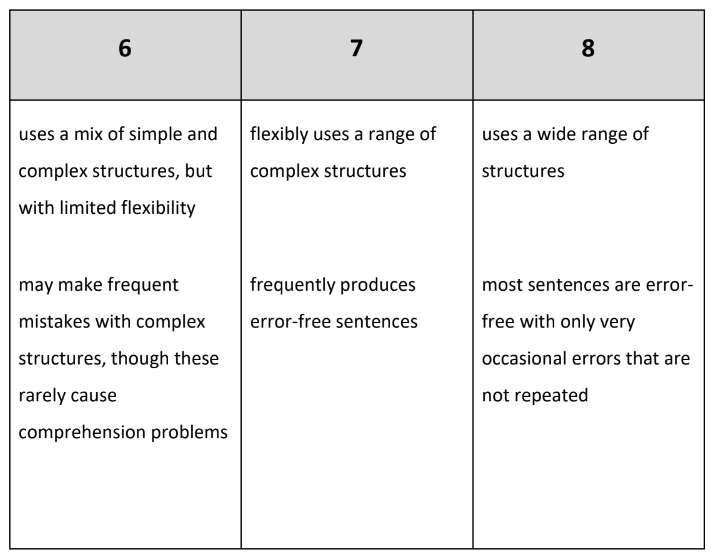
To score highly you need to avoid grammatical errors, such as with articles and prepositions and sentence order especially when they make your speaking difficult to understand and also use a variety of sentence types (simple, compound, complex, passive). Using lots of complex sentences is particularly important. These are sentences that have a dependant and independent clause. Grammar is covered in detail in Chapter 8.
Use complex sentences
To score well for grammar requires you to use a wide range of sentence types. Especially, complex sentences which are sentences with a dependent and independent clause. As with my advice regarding vocabulary, I suggest you don't try to learn too many types of sentences. Instead focus on learning a few and learning them really well. My two top suggestions are learning how to use conditional phrases; [if phrases] and relative pronouns [who, which, that, when], which enable you to add extra information about the subject of the sentence. This is covered in more detail in Chapter 8.
Tenses
For the most part you can limit the number of errors with tenses by just sticking to the tense of the question. If the examiner is asking you a question about your childhood then it is likely that your answer is going to be in the past tense. When you read the Part Two question card you should think about what tenses you need to use in your answer.
Word order
This type of error is very serious and easily noticed by the examiner. A common cause is due to differences in the sentence structure between your native language and the English language. It is a good idea to become aware of what the main differences are. You may need to frequently review these differences.
Prepositions and Articles
Errors with prepositions [in on at]; and articles [a, an, the] are minor and are likely to be not noticed or forgiven by examiners. However, if you frequently make mistakes with these then it will start to limit your score for grammar. Repeated errors make it difficult to get to 7 and almost impossible to get to 8. As with other aspects of grammar you need to review the rules and perhaps do some quizzes to become more familiar with them.
1.2 PREPARING FOR YOUR TEST
To improve your score in the IELTS speaking section, you should focus on the following areas:
- Understanding how the speaking test is graded
- Preparing for and practicing common questions that are asked
- Learning ways of structuring your answers to extend your answers and to improve your coherence
- Learning to paraphrase, which is when you use a phrase to explain a word you can't think of
- Improving your pronunciation, and ensuring you can make all sounds correctly (th, l, r, long vowel sounds) and also getting natural sounding stress, intonation, and connected speech.
- Improving spoken grammar by correcting any frequent errors, and learning to use a couple of complex sentence structures such as conditional phrases or relative pronouns.
- Broadening your vocabulary especially by building common phrases that can be used for a variety of responses, such as connectives and linking words and idiomatic language.